Modular UAV Airframe Design and Manufacturing Process
PURA UAV Team | Publication Date: August 2026
Unmanned Aerial Vehicles (UAVs) are widely used today in various fields such as defense, search and rescue, mapping, and autonomous missions. In this project, the mechanical design and manufacturing of a modular quadcopter UAV were carried out to meet the requirements of the SUAS competition while achieving high structural strength and low weight. The primary objective of the design process was to minimize the overall weight while maintaining structural rigidity, create a modular structure that facilitates maintenance and transportation, and prioritize manufacturability.
The UAV consists of two carbon fiber main body plates measuring 25 × 25 cm. Owing to the high strength-to-weight ratio of carbon fiber, the airframe provides both lightweight construction and excellent structural durability. The entire mechanical design was developed using SolidWorks CAD software, where all components were modeled, assembled, and validated through structural analyses.
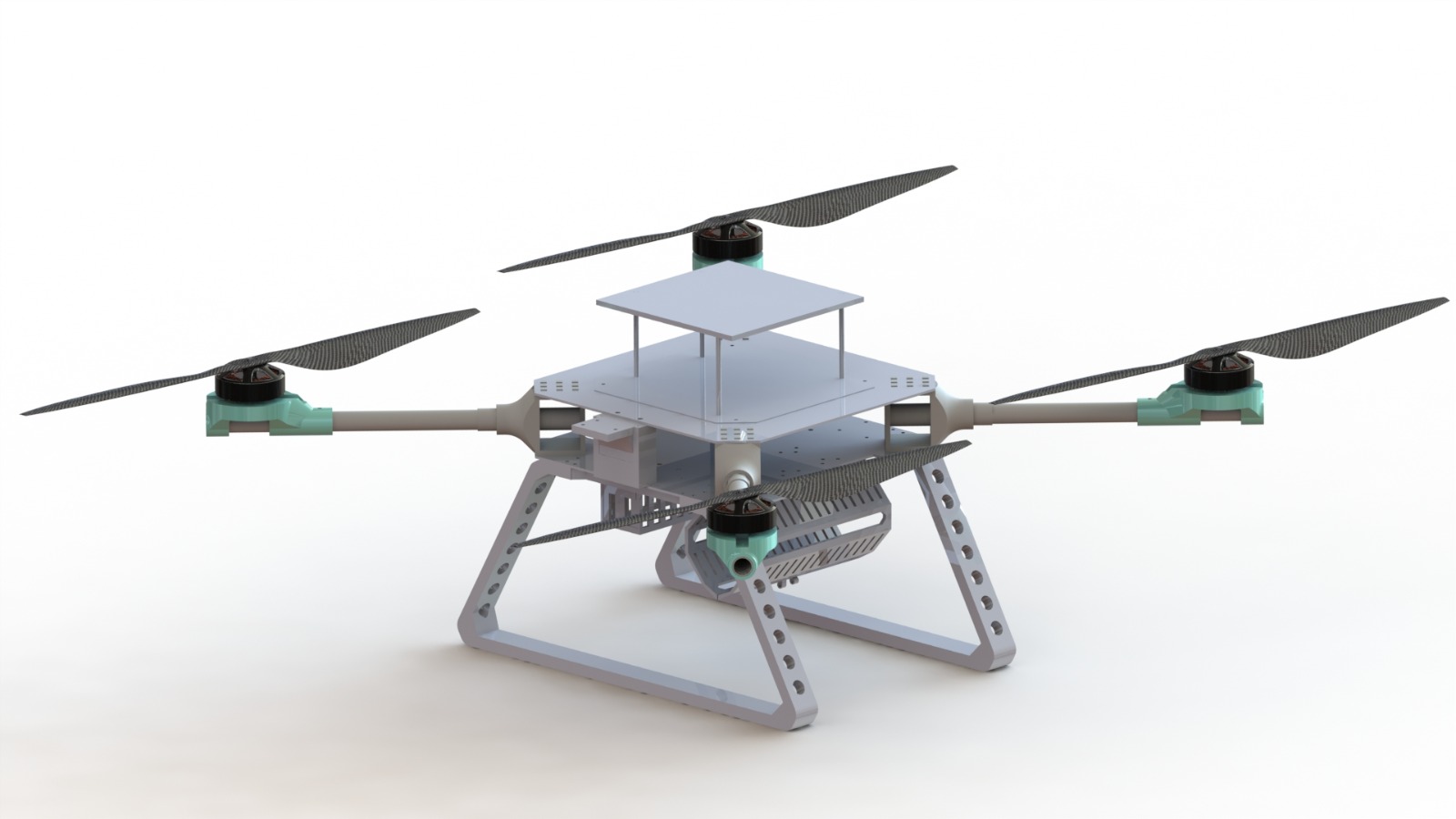
Airframe Design
The UAV airframe was designed around a compact structure formed by upper and lower carbon fiber plates. These main body plates not only provide secure mounting locations for the electronic systems but also serve as the primary load-bearing structure supporting the arms and mission mechanisms.
The carbon fiber plates were manufactured using waterjet cutting technology. This process prevents heat-induced deformation in carbon fiber materials while ensuring high manufacturing precision. As a result, the dimensions specified during the design stage were transferred to production with excellent accuracy.
One of the primary design objectives was to minimize the use of mechanical fasteners. Unlike conventional assembly methods, many structural joints were bonded using epoxy adhesive. This approach not only reduced the overall weight but also minimized unnecessary metallic components at connection points, resulting in a cleaner and more rigid structure.
Manufacturing of Carbon Fiber Arms
The UAV arms were manufactured from carbon fiber tubes. The tubes were cut to the required dimensions and prepared for integration with the main airframe.
One of the key features of the design is its modular arm structure. Each arm was designed to be independently removable and replaceable. This configuration allows damaged or worn arms to be replaced without disassembling the entire airframe, significantly simplifying maintenance, repair, and transportation. Since time efficiency is critical during competitions, this modular approach provides an important operational advantage.
To ensure precise integration between the arms and the airframe, the connection components were designed as three-dimensional CAD models and manufactured using 3D printing technology.
Mechanically Printed Components Manufactured by 3D Printing
In addition to the carbon fiber structural elements, numerous auxiliary mechanical components were manufactured using 3D printing technology. This approach reduced production costs while enabling rapid implementation of design modifications whenever necessary.
The primary 3D-printed components include:
- Airframe-to-arm connection brackets
- Motor mounts
- Landing gear components
- Structural support elements
- Auxiliary assembly components
During the design of these parts, not only geometric compatibility but also weight optimization was carefully considered. Unnecessary material usage was minimized to produce lightweight structures with sufficient mechanical strength. Consequently, the total UAV weight was reduced, contributing positively to overall flight performance.
Mechanical Design Process
The complete mechanical design of the UAV was developed in the SolidWorks environment. Initially, the airframe, arms, and connection components were modeled individually. Subsequently, the complete assembly was created to verify compatibility and proper interaction among all components.
Throughout the design process, manufacturability was considered a fundamental criterion. The dimensions of the carbon fiber plates, the placement of the carbon fiber tubes, and the assembly tolerances of the 3D-printed components were all incorporated into the design stage.
After completing the CAD models, structural analyses were conducted. Particular attention was given to the deformation behavior of the airframe and arm connections. Critical stress concentrations were evaluated, and necessary design improvements were implemented before manufacturing. This process significantly reduced the likelihood of mechanical issues during production.
Manufacturing and Assembly Process
The manufacturing process began with the waterjet cutting of the carbon fiber plates. Simultaneously, the carbon fiber tubes were prepared to the required lengths, and their surface finishing processes were completed.
During the initial assembly stage, the upper and lower carbon fiber plates were joined with the airframe-arm connection components to form the primary structure. Subsequently, the modular carbon fiber arms were assembled and installed independently.
After completing the main load-bearing structure, the motor mounts, landing gear, and other supporting components were installed. Finally, the mechanical components of the mission mechanism were integrated, completing the mechanical assembly of the UAV.
Throughout the assembly process, special attention was given to ensuring precise alignment between all components. Minor tolerance adjustments were performed where necessary to improve assembly accuracy.
Testing and Validation
Following manufacturing, a series of mechanical validation tests were conducted. Initially, the integrity of all structural joints was inspected, and the durability of the modular arm mechanism during repeated assembly and disassembly operations was evaluated.
Static load tests were then performed to investigate potential loosening or deformation at structural connection points. The motor mounting interfaces and landing gear were inspected for mechanical strength, while possible vibration sources were also assessed.
Finally, the overall structural integrity of the assembled UAV was verified to ensure that all mechanical components operated together as intended. The results confirmed that the design achieved the targeted structural performance. Minor improvements identified during testing were implemented before completing the manufacturing process.
Conclusion
Within the scope of this project, the mechanical design and manufacturing of a lightweight, durable, and modular UAV suitable for the SUAS competition were successfully completed. By combining the superior mechanical properties of carbon fiber with the design flexibility offered by 3D printing technology, a platform that is both highly manufacturable and easy to maintain was developed.
One of the most significant achievements of this project was the successful implementation of an airframe design that substantially reduced the use of mechanical fasteners without compromising structural strength. The combination of epoxy-based structural bonding and optimized 3D-printed components resulted in a lighter airframe and reduced the total system weight.
Furthermore, the modular arm design greatly simplified maintenance and component replacement procedures. The manufacturing experience gained throughout this project provides a valuable engineering foundation for the development of future UAV platforms. Overall, this work represents a successful example of mechanical design in which lightweight construction, structural strength, manufacturability, and modularity were effectively integrated.